
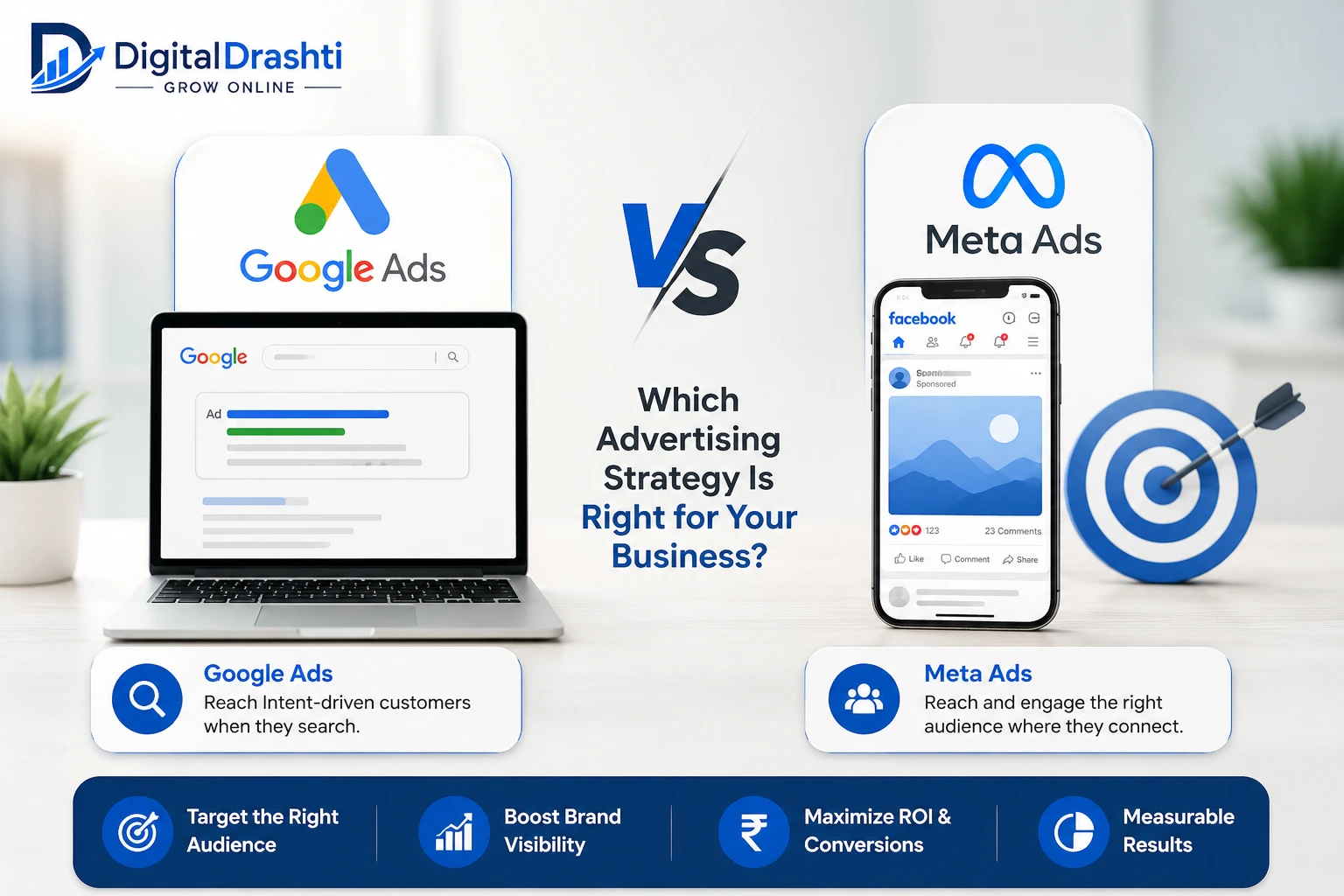
Google Ads vs Meta Ads: Which Advertising Strategy Is Right for Your Business?
Introduction
Online advertising has become an important part of digital marketing. Businesses use paid ads to reach potential customers, generate leads, increase sales, and build brand awareness.
Two popular platforms for online advertising are Google Ads and Meta Ads. Both can help businesses reach the right audience, but they work in different ways.
Google Ads mainly connects businesses with people who are actively searching for a product or service. Meta Ads, on the other hand, helps businesses reach people through platforms like Facebook and Instagram based on their interests, behaviour, demographics, and online activity.
Choosing between the two depends on factors such as:
In this blog, we will compare Google Ads vs Meta Ads and understand their key differences, targeting methods, costs, benefits, and use cases. This will help you choose the advertising strategy that fits your business best.
What Are Google Ads?
Google Ads is an online advertising platform by Google that allows businesses to show paid advertisements to potential customers.
When people search for a product, service, or solution on Google, relevant ads can appear in the search results.
For example:
If someone searches for “digital marketing agency near me,” businesses offering digital marketing services can show their ads for that search.
How Google Ads Works
Google Ads mainly focuses on search intent. This means businesses can reach people who are already looking for something related to their product or service.Businesses can target their ads using:
Why Businesses Use Google Ads
Google Ads can be useful when a business wants to:
In simple terms:
Customer searches on Google → Your ad appears → Customer clicks → Customer may become a lead or customer.
What Are Meta Ads?
Meta Ads is an advertising platform that allows businesses to promote their products and services on platforms like Facebook and Instagram.
Unlike Google Ads, users do not always have to search for a product or service first. Meta Ads can appear while people are browsing their social media feeds based on their interests, behaviour, demographics, and activity.
How Do Meta Ads Work?
For example, imagine someone regularly watches fitness-related content on Instagram. A fitness brand can target an audience interested in fitness and show its ad to potential customers.
This makes Meta Ads useful for discovering new audiences and creating interest in a product or service.
When Are Meta Ads Useful?
Meta Ads can be a good option when a business wants to build brand awareness, reach new audiences, promote products, or generate leads.
Simple example:
Target Audience → Sees the Ad → Shows Interest → Visits Website/Profile → Takes Action
Meta Ads can be especially effective for businesses where visual content and audience interests play an important role in the buying decision.
Google Ads vs Meta Ads – Key Difference
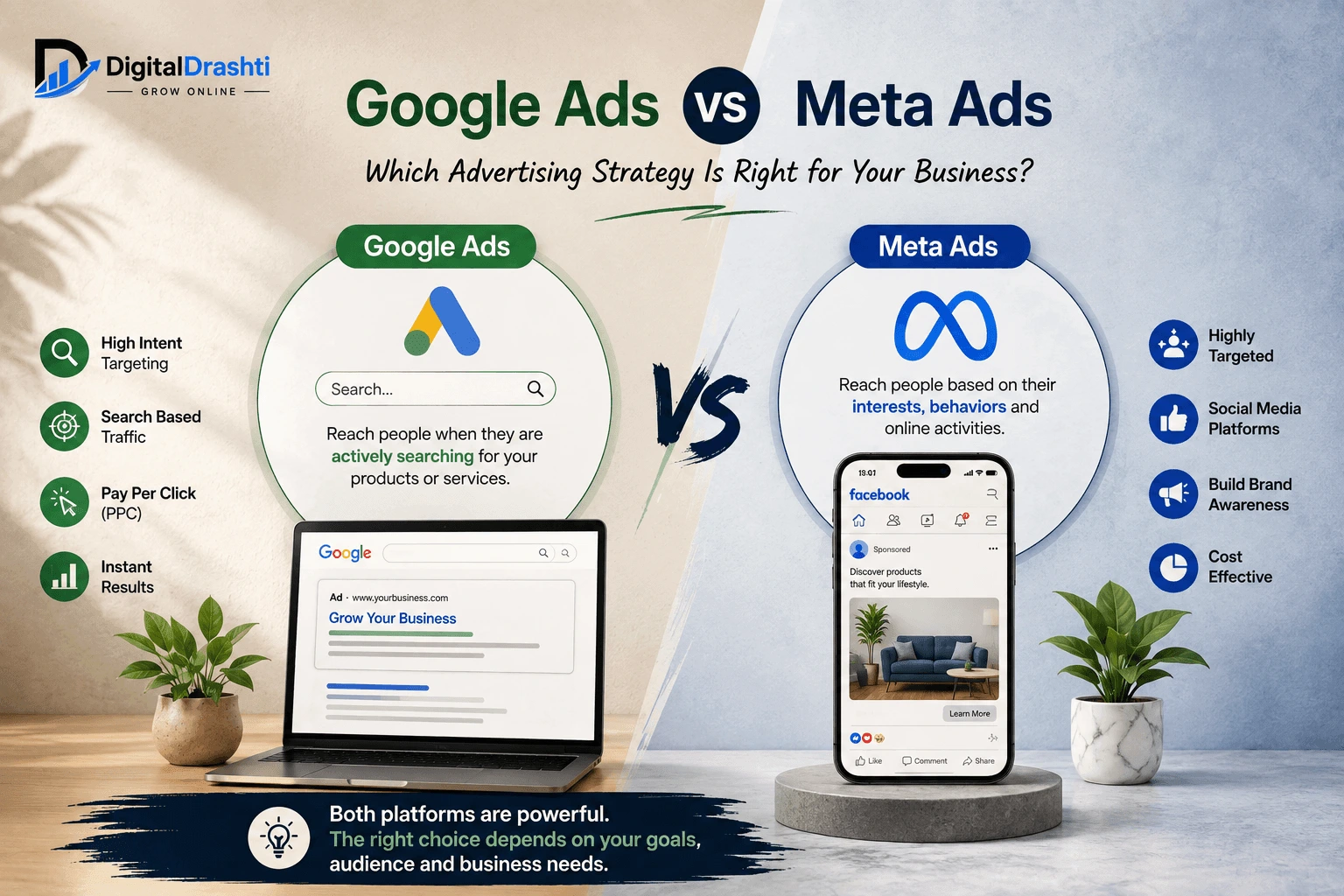
Google Ads and Meta Ads both help businesses reach potential customers, but they do it at different stages of the customer journey.
Google Ads focuses more on existing demand. A person searches for something they already need, and relevant ads can appear at that moment.
Meta Ads focuses more on discovery and awareness. A person may not be actively looking for a product, but a well-targeted ad can introduce them to a brand or offer.
A Simple Example
Imagine you run a digital marketing agency.
Someone searches Google for “SEO services for small business.”
→ Google Ads can help you reach that person because they already have an interest or need.Now imagine someone is scrolling through Instagram and sees an interesting post about improving website traffic.
→ Meta Ads can introduce your agency to that person even though they were not actively searching for SEO services.
Google Ads vs Meta Ads – Targeting
Targeting is one of the biggest differences between Google Ads and Meta Ads. Both platforms allow businesses to reach specific audiences, but they use different signals to decide who should see an ad.
Google Ads Targeting
Google Ads mainly uses search intent and keywords. When someone searches for a specific product or service, businesses can show ads that match that search.
For example, a person searching “best web development services” already has a clear interest in finding a service. This makes Google Ads useful for reaching people who are closer to taking action.
Meta Ads Targeting
Meta Ads focuses more on who the person is and what they are interested in. Businesses can build audiences using factors such as interests, demographics, location, behaviour, and previous interactions.
For example, a business selling fitness products can reach people interested in fitness, sports, or related content, even when they are not actively searching for those products.
Google Ads vs Meta Ads – Cost and Budget
Cost is one of the first things businesses consider before starting a paid advertising campaign. However, there is no fixed answer to which platform is cheaper.
The actual cost depends on factors such as industry, competition, audience, location, ad quality, campaign objective, and budget.

Google Ads Cost
Google Ads commonly uses a pay-per-click (PPC) model, where businesses may pay when someone clicks on their advertisement. Competitive keywords can have higher costs because multiple businesses may be targeting the same searches.
For example, keywords related to insurance, finance, or legal services can be more competitive than keywords in less competitive industries.
Meta Ads Cost
Meta Ads can work with different campaign objectives, such as awareness, traffic, leads, or sales. The cost can change depending on the audience, competition, creative quality, and campaign goal.
Meta can be useful for reaching a larger audience and testing different creative ideas within a controlled budget.
Google Ads vs Meta Ads for Lead Generation
Lead generation is an important goal for businesses that want potential customers to contact them, submit an enquiry, or request a service.Both Google Ads and Meta Ads can generate leads, but they approach potential customers differently.
Google Ads for Lead Generation
Google Ads can be effective when people are actively searching for a solution.
For example, someone searches for “digital marketing course near me” or “SEO agency for small business.” If your ad appears for that search, the person may already have a strong reason to enquire.
This makes Google Ads particularly useful for service-based and local businesses where search intent is important.
Meta Ads for Lead Generation
Meta Ads can generate leads by reaching people based on their interests, behaviour, demographics, and previous interactions.
For example, a training institute can promote a course to people who may be interested in learning digital marketing, even if they are not currently searching for a course.
Meta also offers formats such as lead forms, which can make it easier for interested users to submit their details directly.
Which Is Better for Leads?
It depends on where your potential customers are in their buying journey.
Google Ads → People already looking for a solution
Meta Ads → People who may be interested in discovering a solutionFor some businesses, using both platforms together can create a stronger lead generation strategy.
Google Ads vs Meta Ads for Different Business Types

There is no single advertising platform that works equally well for every business. The better choice often depends on what you sell, who your customers are, and how they make buying decisions.
Local Businesses
For businesses such as salons, clinics, restaurants, or local service providers, Google Ads can be useful when customers actively search for nearby services.Meta Ads can also help local businesses create awareness and promote special offers within a specific location.
E-commerce Businesses
E-commerce brands can benefit from both platforms. Google Ads can capture product searches, while Meta Ads can showcase products through visual content and reach new audiences.
B2B Businesses
B2B companies often depend on specific searches and business-related needs, making Google Ads useful for reaching people actively looking for solutions.
Meta Ads can support awareness and retargeting as part of a wider strategy.
New Businesses
New businesses may benefit from Meta Ads when the goal is to introduce the brand to a new audience and build awareness.
Once people start searching for the brand or service, Google Ads can help capture that demand.
When Should You Choose Google Ads?
Google Ads can be a strong choice when your potential customers are already searching for the products or services you offer.
For example, if someone searches for “best SEO agency near me,” they already have a specific requirement.
Showing your ad at that moment can help you connect with a high-intent potential customer.
Google Ads may be right for your business when:
Google Ads is especially useful when your business can clearly match its advertising with specific customer searches and needs.
When Should You Choose Meta Ads?
Meta Ads can be a good choice when your goal is to reach new audiences, create brand awareness, and generate interest in your products or services.
Unlike Google Ads, where people usually search for something they already need, Meta Ads helps businesses introduce their offerings to people who may not know about them yet.
For example, a new fashion brand can show attractive product images or videos to people who are interested in fashion, even if they are not currently searching for clothes.
Meta Ads may be right for your business when:
Meta Ads works especially well for businesses that want to build relationships with audiences and create interest before the customer makes a purchase decision.
Google Ads vs Meta Ads: Which One Is Right for You?
There is no single platform that is perfect for every business. The right choice between Google Ads and Meta Ads depends on your goals, audience, industry, and customer journey.
If your customers are actively searching for a product or service, Google Ads can help you reach them at the right moment.
If your goal is to build brand awareness, discover new audiences, or promote products through engaging content, Meta Ads can be a strong option.
Choose Google Ads when:
Choose Meta Ads when:
For many businesses, the best approach is not choosing only one platform. A combination of Google Ads and Meta Ads can help attract new customers, build interest, and convert potential buyers.